How Sculptra Rebuilds Collagen: A Guide to Gradual Facial Rejuvenation in Jacksonville
Facial aging doesn't happen overnight, and rejuvenation doesn't have to either.
Over time, natural changes in collagen, facial fat, and bone structure can affect how your face looks. You may begin noticing flatter cheeks, deeper facial folds, or a loss of the fullness that once gave your face a rested appearance.
For patients interested in gradual improvement rather than an immediate transformation, Sculptra offers a different approach to facial rejuvenation.
Unlike traditional hyaluronic acid fillers that provide more immediate volume, Sculptra stimulates your body's natural collagen production. Its effects develop progressively, allowing changes to become visible over time.
At Ageless Rejuvenation Center in Mandarin, Jacksonville, we take a personalized approach to Sculptra treatment, considering your facial anatomy, aesthetic goals, and individual treatment needs.
Here's what to know about how Sculptra works, when results develop, and whether it may be the right option for you.
What Is Sculptra and How Does It Stimulate Collagen?
Sculptra is an FDA-approved injectable treatment made with poly-L-lactic acid (PLLA), a biocompatible, biodegradable substance that helps stimulate collagen production.
Collagen is an important structural protein that helps support the skin's firmness and resilience.
As we age, changes in collagen production, facial fat, and underlying bone structure can contribute to:
Loss of facial fullness
More noticeable facial folds
Changes in cheek contours
Reduced skin firmness
A tired or hollow appearance
Sculptra works by encouraging a gradual collagen response in the treated tissue.
Rather than relying primarily on immediate gel-based volume, its effects develop as the body responds to the injected PLLA particles over time.
This makes Sculptra an option for appropriate patients who prefer progressive facial rejuvenation.
How Is Sculptra Different From Traditional Fillers?
Traditional hyaluronic acid fillers provide more immediate volume or contour changes by placing a gel beneath the skin.
Sculptra, on the other hand, encourages collagen production over time. Its initial appearance is not the same as its eventual result.
Both approaches can be useful, but they serve different treatment goals.
When Will You See Results From Sculptra?
One of the most important things to understand about Sculptra is that results develop gradually.
Immediately after treatment, you may notice increased fullness in the injected areas. This early appearance can result from the fluid used to prepare Sculptra and temporary swelling associated with the injections.
As that fluid and swelling resolve, some of the initial fullness may decrease.
This is an expected part of the process and does not necessarily indicate that the treatment has stopped working.
Over the following weeks and months, collagen stimulation may produce gradual visible improvement.
Depending on your treatment plan and individual response, you may notice:
Softer-looking facial folds
Improved-looking facial contours
A more refreshed appearance
Gradual changes in facial support
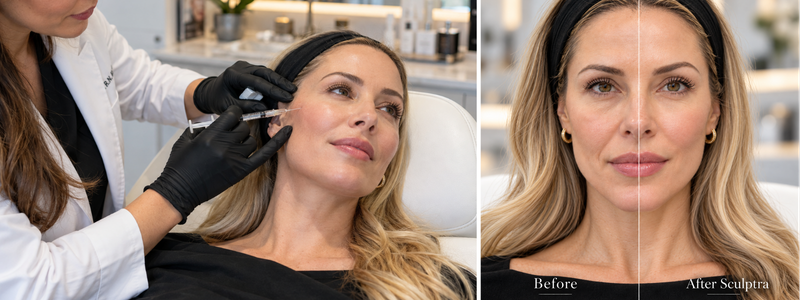
Because the changes happen progressively, results may be easier to appreciate when comparing photographs taken several weeks or months apart.
Why Do Sculptra Results Take Time?
Collagen production is a biological process that requires time.
Sculptra does not produce its intended long-term effect immediately after injection. The body gradually responds to the PLLA particles, and visible changes develop as that response progresses.
Your provider can help establish realistic expectations for when results may become noticeable and how your treatment plan will be evaluated.
How Long Do Sculptra Results Last?
Sculptra is designed to provide gradual, longer-lasting aesthetic improvement.
Clinical studies supporting certain FDA-approved facial indications have demonstrated results lasting up to 24 months.
However, this does not mean every patient will experience the same duration or degree of improvement.
Results depend on factors such as:
Individual collagen response
Treatment area
Number of treatment sessions
Amount of product used
Facial anatomy
Ongoing age-related changes
Some patients may benefit from future maintenance treatments. During your consultation, your provider can explain what results may be realistic for your individual treatment plan.
How Many Sculptra Treatments and Vials Will You Need?
There is no universal number of Sculptra vials or treatment sessions that works for everyone.
Some patients may need a smaller treatment plan, while others may require several sessions to address their concerns.
Your provider will consider:
Facial anatomy and proportions
The areas being evaluated
Degree of age-related volume change
Existing facial support
Desired improvement
Previous aesthetic treatments
Individual response to treatment
A treatment series may be recommended, with appointments spaced apart to allow assessment and gradual improvement.
Is More Sculptra Better?
Not necessarily.
Using more product does not automatically create better or more natural-looking results.
Appropriate product selection, injection technique, treatment timing, and individual anatomy all matter.
At Ageless, the focus is on developing an individualized plan rather than recommending a particular number of vials simply because another patient received that amount.
What Areas Can Sculptra Treat?
Sculptra has FDA-approved indications that include correction of certain facial folds and wrinkles, including fine lines and wrinkles in the cheek region for appropriate adult patients.
A consultation is necessary to determine whether the treatment is suitable for the specific concern and anatomical area.
Your provider may evaluate changes involving:
Cheek wrinkles
Nasolabial folds
Certain facial contour changes
Age-related volume concerns
Not every facial area or proposed use of Sculptra is FDA-approved. Your injector should explain whether a recommended treatment is within the product's approved indications or would be an off-label use.
The goal is to identify the approach best suited to your anatomy and desired results.
Sculptra vs. Dermal Fillers: Which Is Better?
Neither treatment is universally better.
The right choice depends on what you're hoping to improve and how quickly you want to see changes.
Treatment | Sculptra | Hyaluronic Acid Fillers |
|---|---|---|
How it works | Stimulates gradual collagen production | Provides gel-based volume |
Results | Develop progressively | More immediate visible change |
Common goals | Gradual improvement in approved facial concerns | Targeted volume, shaping, or contouring |
Treatment plan | May require a series | Depends on product, area, and goals |
Duration | Results may last up to 24 months for certain indications | Varies by product and indication |
For example, someone looking for a targeted change in lip shape may have different treatment needs than someone exploring gradual improvement in age-related facial changes.
Some patients may benefit from different injectable treatments at different times, but combining procedures should always be based on clinical assessment.
For a deeper comparison, read our guide to how providers choose dermal fillers in Jacksonville.
How Does Sculptra Compare With Botox and SkinPen?
Sculptra, Botox, and SkinPen can all be part of conversations about facial rejuvenation, but they work differently.
Sculptra vs. Botox
Botox treatments in Jacksonville temporarily reduce activity in selected facial muscles that contribute to expression lines.
Sculptra does not relax facial muscles. Instead, it stimulates collagen production in treated tissue.
A patient concerned about forehead expression lines may benefit from a different approach than someone concerned about age-related cheek wrinkles or facial folds.
Sculptra vs. SkinPen Microneedling
SkinPen microneedling creates controlled microinjuries that activate the skin's natural healing response.
Depending on its approved indication and patient suitability, SkinPen may be considered for concerns such as facial acne scars and neck wrinkles.
Sculptra is an injectable collagen stimulator used for specific facial indications.
Although both involve collagen-related processes, they differ in treatment method, tissue effects, approved uses, and expected results.
Your provider can help determine whether one option, another treatment, or a carefully planned combination is appropriate.
What Is Recovery Like After Sculptra?
Sculptra is administered through injections, so temporary reactions can occur.
Common effects may include:
Swelling
Redness
Tenderness
Bruising
Injection-site discomfort
Temporary fullness shortly after treatment may decrease as swelling and preparation fluid resolve.
Although many patients return to routine activities relatively quickly, individual recovery experiences vary.
Your injector will provide specific instructions based on your treatment and medical history.
Should You Massage Your Face After Sculptra?
After Sculptra treatment, your provider may recommend a massage routine to help distribute the product within the treated areas.
The manufacturer's commonly described 5-5-5 routine involves massaging the treated areas for five minutes, five times per day, for five days.
However, always follow the specific instructions provided by your treating clinician, including any adjustments based on your treatment area or circumstances.
If you are unsure how to perform the massage or experience unusual symptoms, contact your provider for guidance.
Is Sculptra Safe? Understanding Potential Risks
Sculptra is FDA-approved for specific indications and has been evaluated in clinical studies. However, as with any injectable procedure, there are potential risks and side effects.
In addition to temporary swelling, bruising, redness, or tenderness, some patients may develop small lumps or nodules beneath the skin. These can occasionally appear weeks or months after treatment and may require medical evaluation.
Rare but serious complications can occur with injectable treatments, including unintended injection into a blood vessel. Seek immediate medical attention if you experience vision changes or symptoms suggesting a vascular complication.
Sculptra is not appropriate for everyone, including individuals with certain severe allergies or a history of keloid or hypertrophic scarring.
Before treatment, your provider should review your medical history, discuss potential risks, and explain whether Sculptra is appropriate for your concerns.
For more information, review the FDA's Sculptra approval and safety information.
Who Is a Good Candidate for Sculptra?
Sculptra may be appropriate for adults who want gradual improvement in facial concerns that fall within its approved indications.
Potential candidates may include patients who:
Prefer progressive rather than immediate changes
Are concerned about selected facial folds or wrinkles
Understand that results take time
Are comfortable with a possible treatment series
Have realistic expectations
However, candidacy cannot be determined by appearance or age alone.
Your provider should consider your medical history, skin condition, prior procedures, allergies, and treatment goals before recommending Sculptra.
If another injectable or skincare treatment is better suited to your concerns, that may be the more appropriate recommendation.
Planning Sculptra Before a Special Event
Because Sculptra works gradually, planning ahead is important.
If you're preparing for a wedding, milestone birthday, family photographs, or holiday celebration, consider scheduling a consultation several months before the event.
This allows time for:
An initial facial assessment
Recommended treatment sessions
Temporary post-treatment effects to settle
Gradual collagen-related changes
Follow-up evaluation
Sculptra is generally not a treatment to begin just days before an event if your goal is to see the full result.
For more detailed guidance, explore our holiday skin treatment planning guide for Jacksonville.
Schedule a Sculptra Consultation in Jacksonville
If you're interested in gradual facial rejuvenation, understanding your options is the first step.
At Ageless Rejuvenation Center in Mandarin, Jacksonville, our providers evaluate your facial anatomy, aesthetic goals, and treatment history before recommending an individualized approach.
You don't need to know how many Sculptra vials you'll need or exactly which areas should be treated before your visit.
Your consultation is an opportunity to discuss what you want to improve, learn what may be realistic, and understand which treatment options are appropriate for you.
Schedule your Sculptra consultation at Ageless Rejuvenation Center to explore your options.
Frequently Asked Questions About Sculptra
1. How does Sculptra work to rebuild collagen?
Sculptra contains poly-L-lactic acid (PLLA), an ingredient that stimulates the body's collagen response after injection. Over time, this process may improve the appearance of certain facial folds and wrinkles, with results developing gradually rather than immediately.
2. How many Sculptra sessions are usually needed?
The number of sessions depends on individual anatomy, treatment goals, and the areas being addressed. Some patients may require a series rather than one appointment. Your provider will recommend an appropriate treatment schedule following an evaluation.
3. How long do Sculptra results last?
Clinical studies have demonstrated results lasting up to 24 months for certain FDA-approved indications. Individual results and duration vary, and some patients may benefit from future maintenance treatments.
4. Who is a good candidate for Sculptra?
Appropriate candidates are adults seeking improvement in facial concerns for which Sculptra may be suitable. Medical history, allergies, scarring tendencies, treatment goals, and individual anatomy should be reviewed before treatment.
5. How does Sculptra compare to traditional dermal fillers in Jacksonville?
Traditional hyaluronic acid fillers provide more immediate volume or contour changes, while Sculptra stimulates gradual collagen production. Your provider can help determine which product or approach is appropriate for your specific goals, facial anatomy, and desired timeline.
Medical Review & References
This article is intended for general educational purposes and does not replace personalized medical advice. Sculptra treatment decisions, expected results, recovery, and suitability should be discussed with a qualified healthcare professional who can evaluate your medical history, anatomy, and individual goals.
Medical References
U.S. Food & Drug Administration (FDA) — Sculptra: FDA Approval and Indications
U.S. Food & Drug Administration (FDA) — Sculptra Patient Information and Safety Labeling
Sculptra / Galderma — Official Product and Patient Information